Vermont's Education Spending Problem, in Charts
An interactive dashboard, some sobering data, and a love letter to a state that needs to have an honest conversation with itself.

A note before we begin: This piece references data from over a dozen sources, including the Vermont Joint Fiscal Office, the National Education Association, NCES, NAEP, the U.S. Census Bureau, the Tax Foundation, and others. A complete source list with links appears at the end of this article. The dashboard itself labels each visualization with its specific source and year. Because I had to pull from different agencies and different school years depending on what was being measured, some numbers (particularly per-pupil spending) differ slightly across views. I explain those differences where they matter, and the disclaimer page on the dashboard goes into greater detail. I'm reasonably confident that the trends and overall picture are more than directionally accurate, but I encourage readers to review the sources and challenge what they find.
I was born in Vermont. My parents were living in California when my mom was pregnant with me. But she had worked in Vermont years earlier and fallen in love with the place, and she was determined that I would be born here. So before I had any say in the matter, Vermont claimed me. I left as a kid, grew up mostly in California, and came back after college because something about this place never let go. That pull, it turns out, is generational. My wife and I are now raising two young daughters in Norwich, where they attend Marion Cross Elementary School. It is a genuinely wonderful school in a genuinely wonderful community, and there is nowhere else our family would rather live.
I’m telling you this upfront because what follows might read like a critique of Vermont, and I want to be clear that it isn’t. It’s a critique of a set of structural trends that, if left unaddressed, threaten to undermine the very things that make this place special. I’m writing this because I love Vermont and because I think we owe it to ourselves to look at the data honestly, even when it’s uncomfortable.
How This Started
A few weeks ago, the Vermont Joint Fiscal Office released a preliminary analysis modeling the financial impacts of Act 73, the state’s sweeping education governance and funding reform signed into law in July 2025. The document (authored by Julia Richter and Ezra Holben, available at vtact73.com/jfo-preliminary-modeling.pdf) estimated what would happen to each proposed district’s funding under the new formula.
Norwich, where I live, was flagged for the largest percentage cut of any district in the state: -34%.
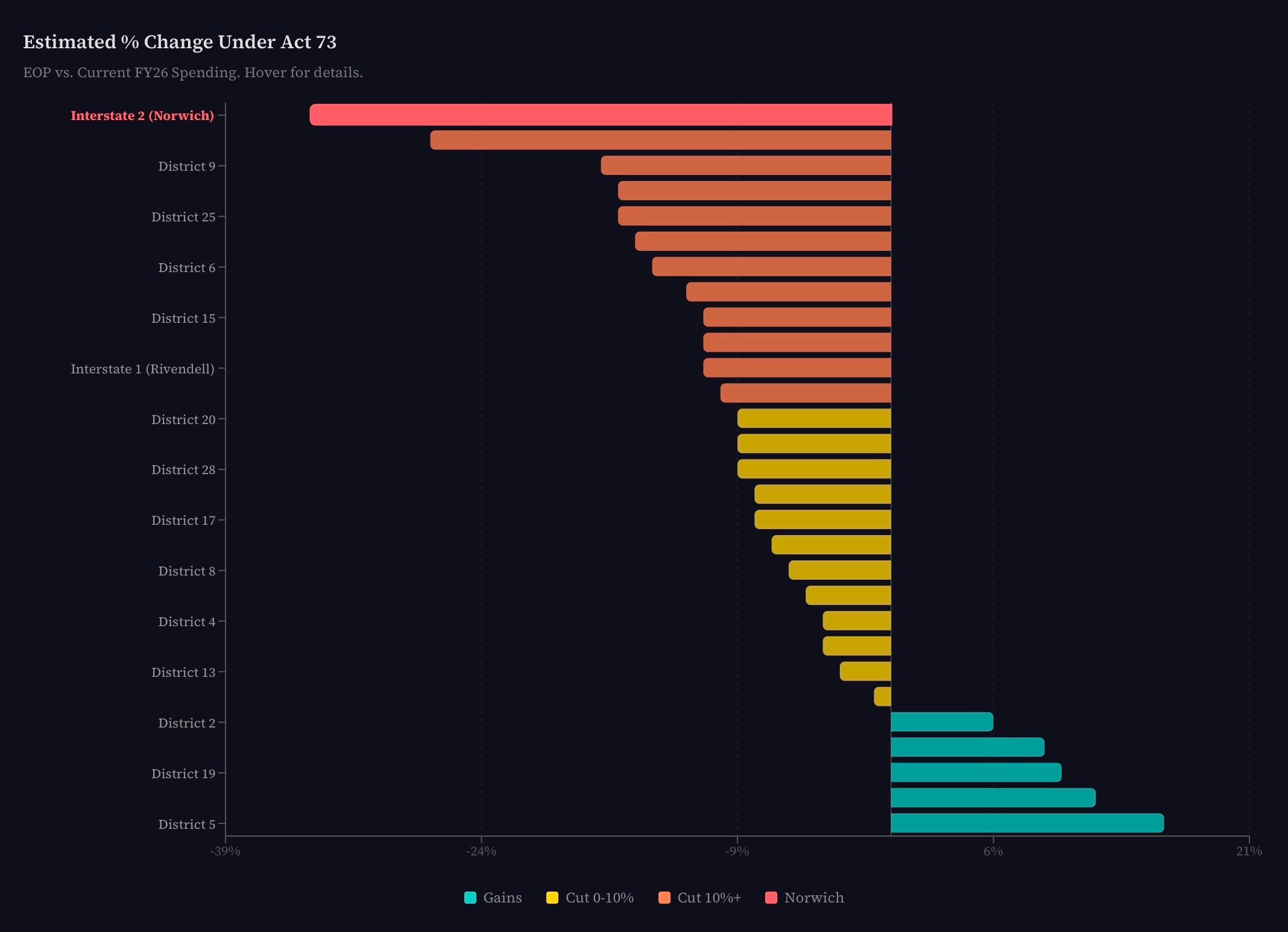
That number got my attention. So I built a dashboard, originally just for myself, to better understand the JFO modeling and to see Norwich’s situation in context. Then I started adding historical data: spending trends, test scores, demographic shifts. At some point, what began as a personal exercise started to feel like something that might help my neighbors, and maybe folks beyond our town, understand the broader picture.
The result is an interactive dashboard at vtact73.com. It’s admittedly Norwich-centric (that’s where I started, and the tax modeler is calibrated to Norwich’s specific situation), but most of the data covers the entire state. I should also note clearly: I am not an expert in public education funding. I’m a technologist who can read data and build visualizations. There are certainly interpretations and nuances that go well beyond what this dashboard captures. I’m sharing it because I think it’s useful, not because I think it’s complete.
I want people to explore the dashboard and draw their own conclusions. But since I’m the one putting it out into the community, I feel obligated to share what stands out to me.
Important Note: The dashboard, is not well optimized for small screens. I highly recommend exploring from a computer or iPad.
The Demographic Story
Vermont is aging. This is not news to anyone who lives here, but the pace and scale of it are worth stating plainly.
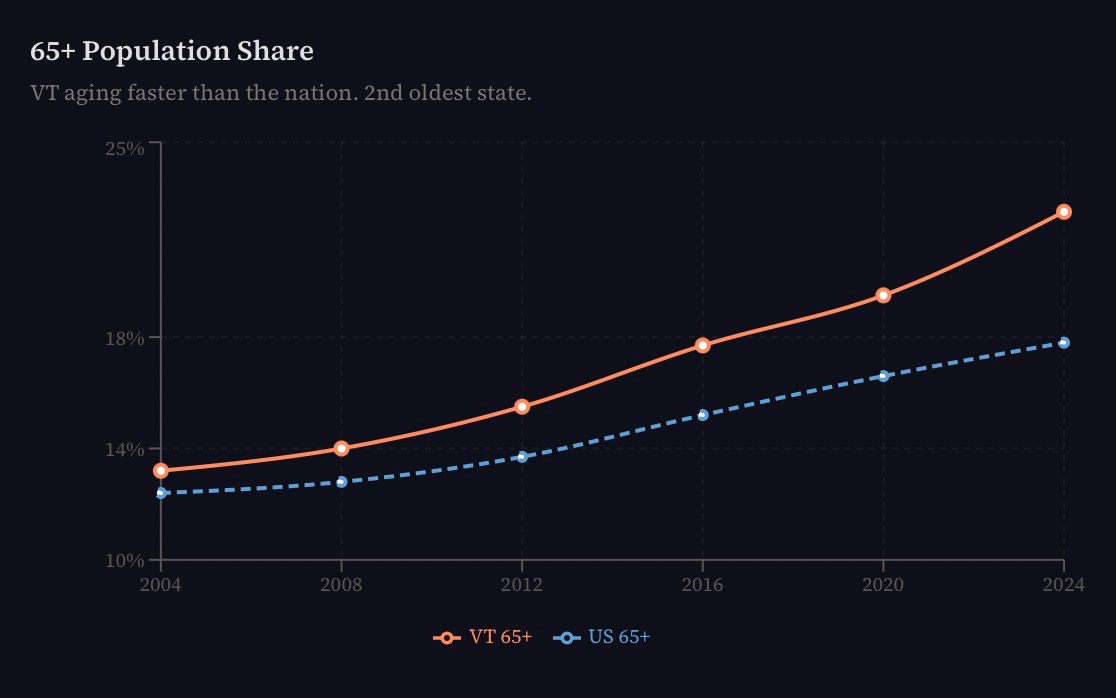
Vermont’s median age is 43, making it the third oldest state in the country. Our over-65 population has nearly doubled in two decades, rising from 13.2% to 22.5%, which is the second highest share in the nation. We have the lowest birth rate of any state. Our total population grew just 4.2% over the past 20 years while the national population grew 16%.
And the number that matters most to this conversation: K-12 enrollment has fallen from roughly 93,500 students in 2004 to about 69,000 today. That’s a 26% decline in two decades, while national enrollment has been roughly flat.
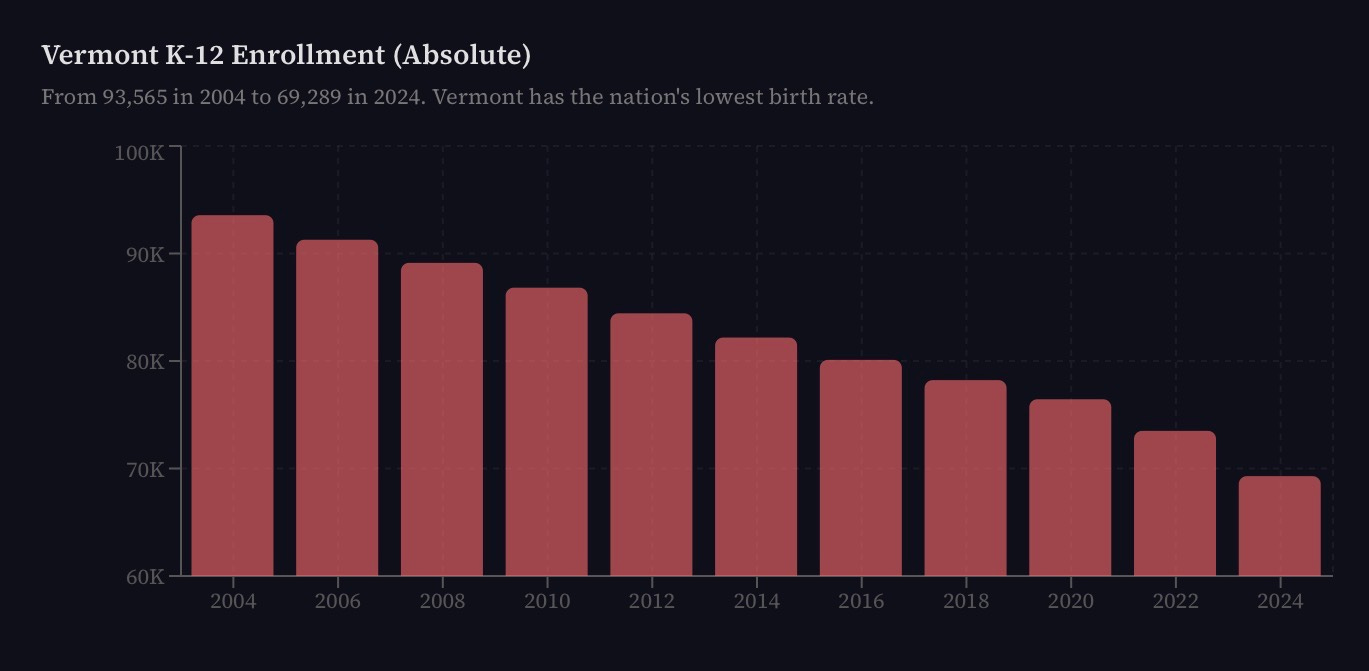
Every other trend in this piece flows downstream from this one. Fewer children means fewer families. Fewer families means a shrinking tax base trying to support an education infrastructure built for a larger population. The per-pupil math gets ugly fast.
The Spending Problem
Vermont bounces between the 2nd and 4th highest per-pupil spending of any state in the country, depending on the year and the source. The NEA’s most recent data (FY 2023-24) puts Vermont at $28,697 per pupil, behind only New York ($31,514). The national average is $16,990. Vermont spends 69% more per student than the typical American state.
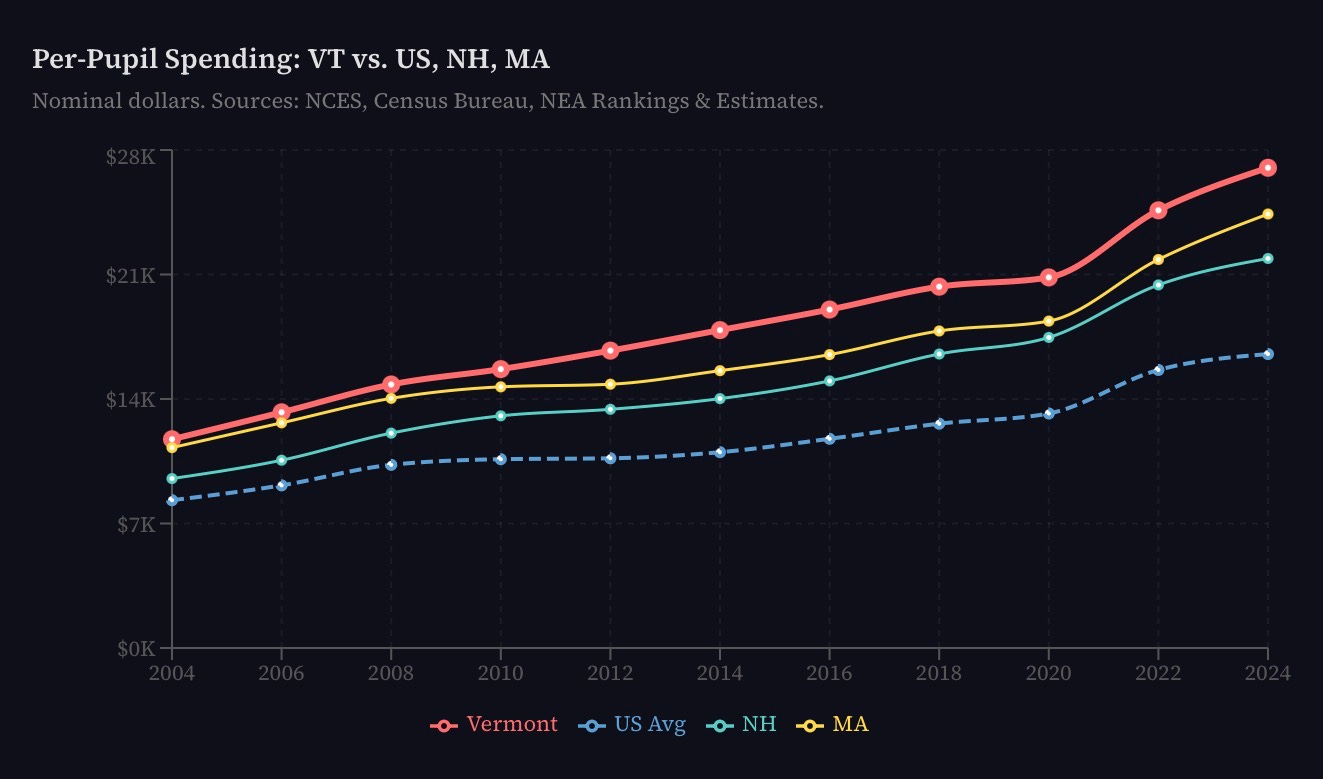
If our outcomes matched our investment, this would be a point of pride. You’d expect to find a state that spends 69% more than average to be producing meaningfully better results. For a while, that was arguably the case. But it hasn’t been for some time.
Outcomes vs. Spending
The NAEP, the “Nation’s Report Card,” tells a sobering story. In 2003, Vermont students outperformed national averages on every measure tested: 4th grade reading, 4th grade math, 8th grade reading, 8th grade math. The margins ranged from 3 to 10 points. Vermont was spending 41% above the national average at the time, and the results seemed to justify it.
By 2024, Vermont students scored at or below national averages on three of the four measures. Eighth grade reading was the most alarming: Vermont experienced the steepest decline of any state between 2019 and 2024, falling below the national average for the first time in the history of the assessment.
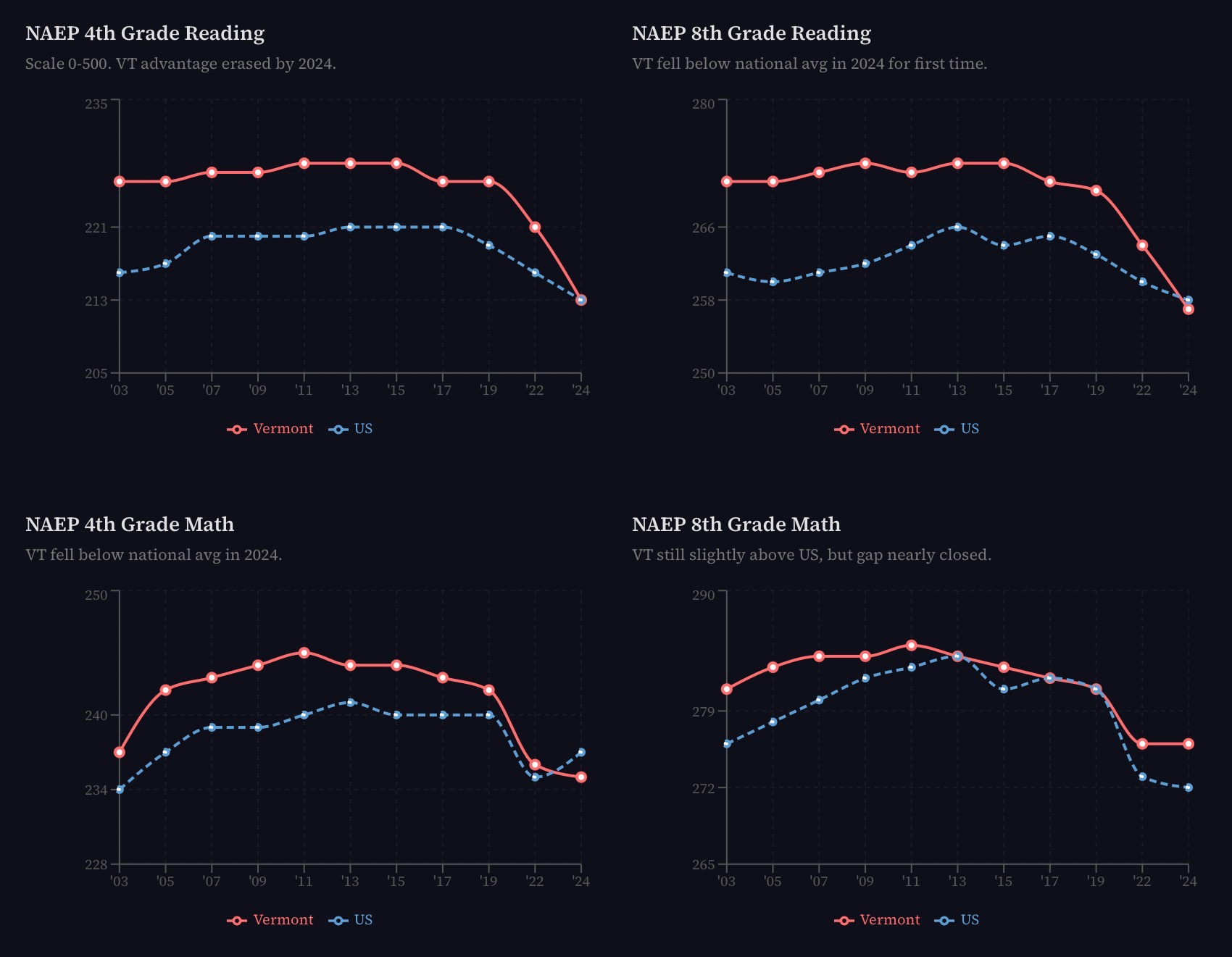
Per-pupil spending roughly doubled over this same period. More money, absent structural reform, did not sustain Vermont’s early advantage. It didn’t even maintain it.
Where the Money Goes (And Doesn't Go)
This is where the data challenges a narrative I hear a lot: that Vermont’s high education spending is about paying teachers well.
It isn’t.
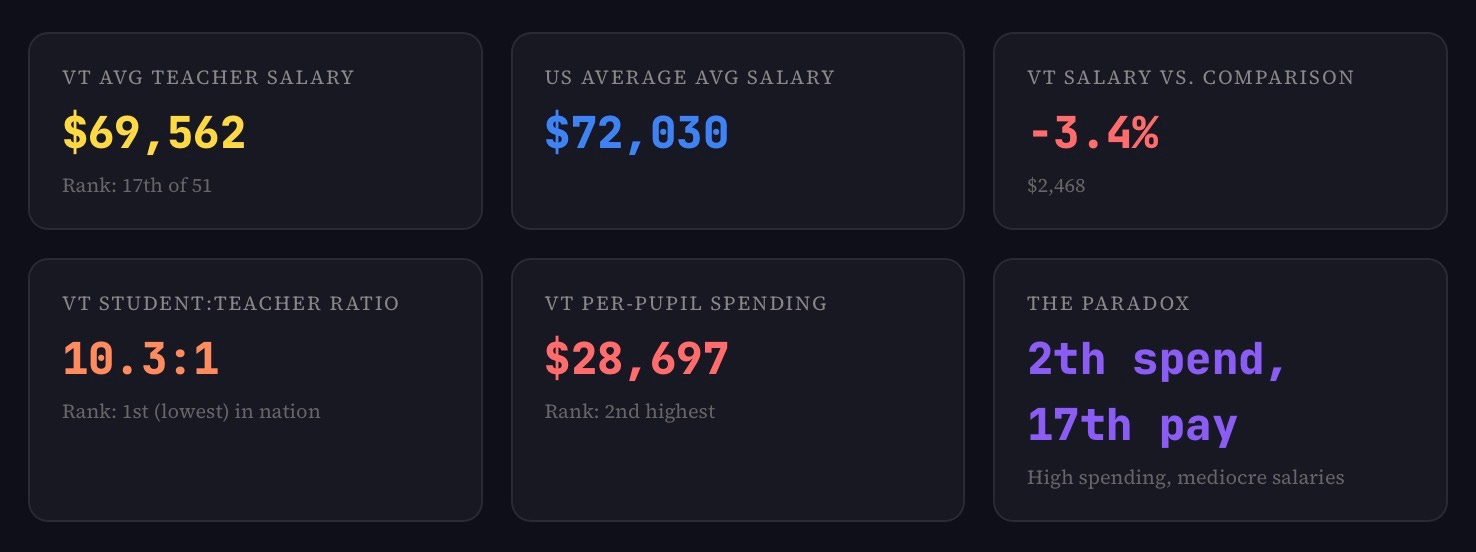
Vermont’s average teacher salary is $69,562, which ranks 17th nationally and falls below the national average of $72,030. Our teachers are not overpaid. If anything, they’re underpaid relative to peers in comparably expensive northeastern states (Massachusetts pays $92,076; Connecticut pays $86,511; New Hampshire pays $67,170).
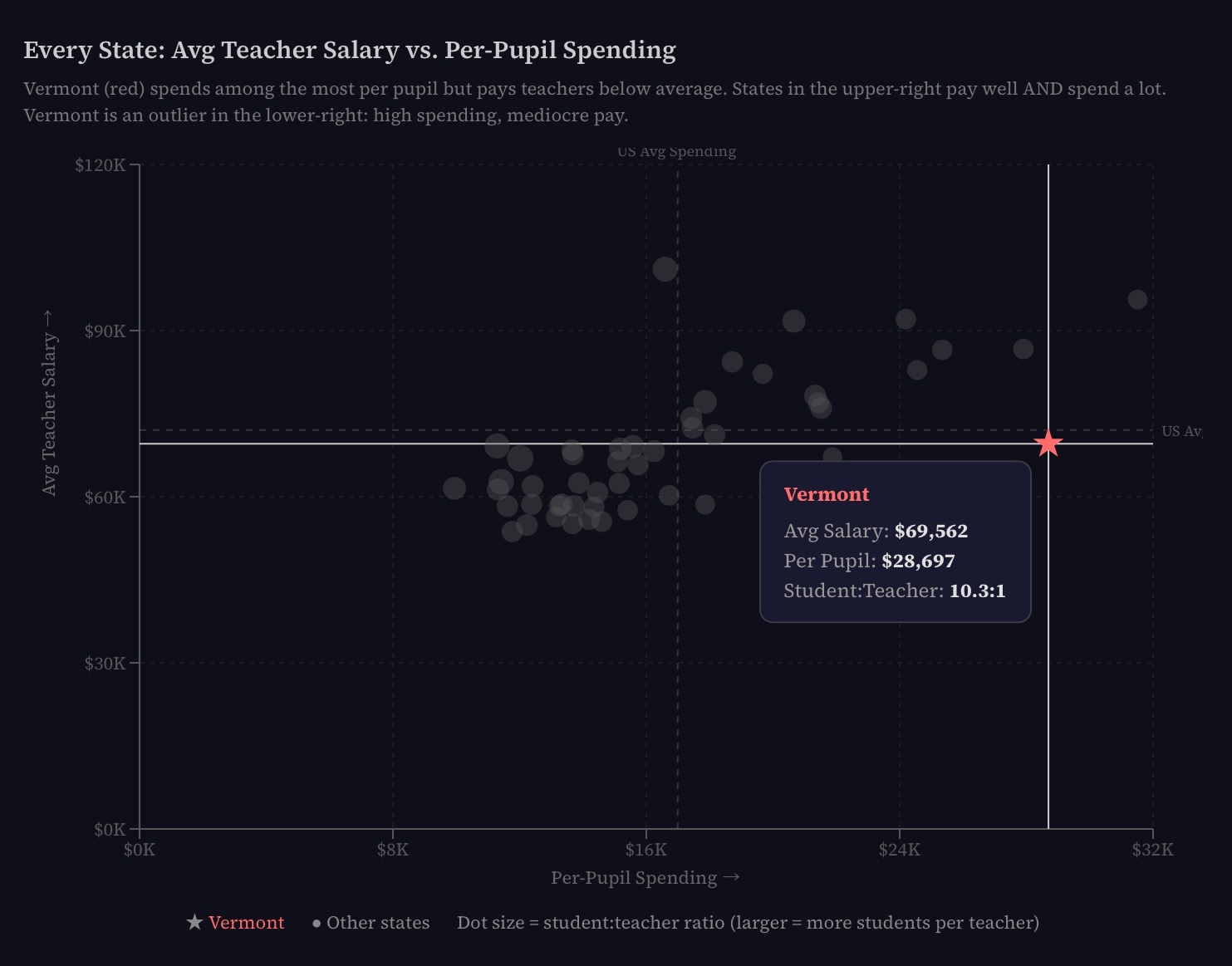
What Vermont does have is the lowest student-to-teacher ratio in the nation: 10.3 students per teacher, versus a national average of 15.1.
Now, an important nuance: this isn’t a story about Vermont failing to reduce its teacher workforce as enrollment dropped. It largely did. According to NCES data, Vermont had roughly 8,460 classroom teachers serving about 94,000 students in 2008 (a ratio of 11.1:1). Today it has approximately 7,960 teachers serving about 82,500 students (10.4:1). The teacher count fell, but not quite as fast as enrollment, which is why the ratio drifted slightly lower. (you can see this in the dashboard’s “Spending Trends” tab, where the VT red line barely moves while the US blue line holds steady around 15:1).
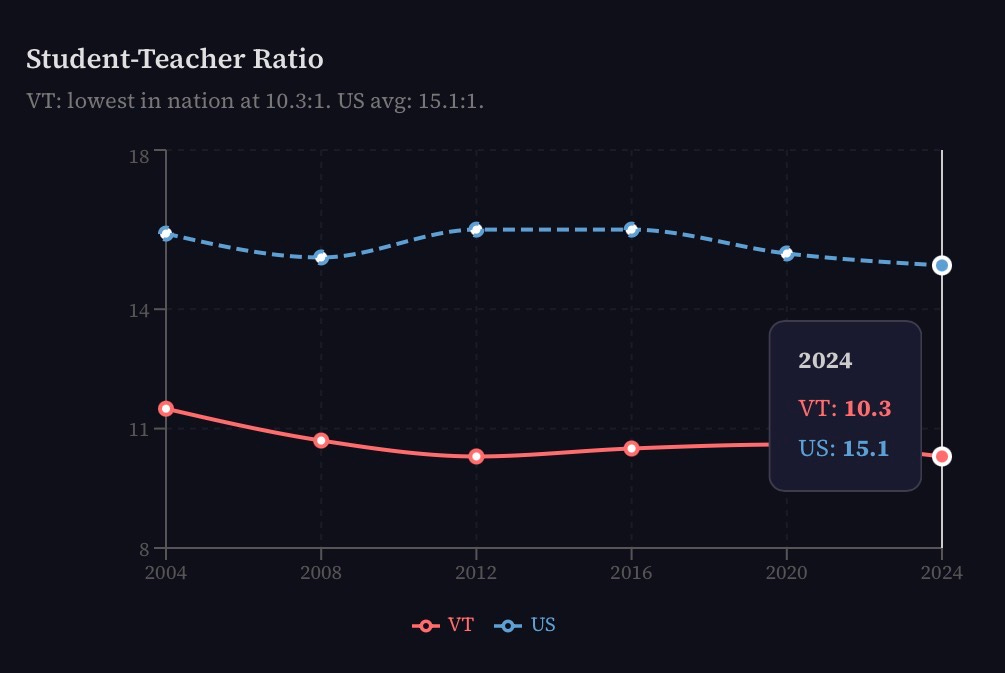
The problem isn’t that we didn’t reduce. It’s that our baseline was already the lowest in the country and we kept it there. Vermont has been operating at roughly 10:1 for two decades while the rest of the country operates at 15:1. That’s 47% more teachers per student than the national norm, year after year, compounded across every school in the state. And since 2019-20, according to the Vermont Agency of Education’s own 2024 State Education Profile, the number of teachers, leaders, and student services staff per 100 students has actually increased, likely boosted by the influx of federal COVID relief funds whose sustainability is now in question.
Meanwhile, per-pupil spending has grown at a faster rate than the national average, and our outcomes have declined. More money, same structure, worse results.
A related cost driver that I hear about frequently, and that deserves honest treatment, is employee healthcare. Vermont has the most expensive health insurance premiums in the nation, 86% above the national average according to ValuePenguin’s analysis of 2025 marketplace data. The Green Mountain Care Board’s own study found that Vermont hospitals charge educators approximately three times the Medicare reimbursement rate, and estimated that adopting reference-based pricing for educators and state employees alone could save nearly $80 million per year. This matters because the Vermont Education Health Initiative (VEHI) covers school employees statewide, and healthcare costs flow directly into school budgets. But here’s the nuance: this is fundamentally a Vermont healthcare problem, not a union negotiation problem. The Vermont-NEA has been among the loudest advocates for structural healthcare cost reform, including reference-based pricing. When people point to teacher benefits as a driver of high education costs, they’re largely pointing at a symptom of Vermont’s broader healthcare affordability crisis, a crisis that affects every employer and every family in the state, not just schools.
And the overhead extends well beyond staffing ratios and healthcare. Vermont’s school administration spending is $1,451 per pupil, nearly double the national average of $818 and the second highest in the country. This is the direct, measurable cost of running 119 separate school districts (plus 52 supervisory unions) for a student population roughly the size of a single mid-sized urban district. Think about that for a moment: a city like Syracuse, New York, or Reno, Nevada, educates a comparable number of students under a single administrative structure.
I want to be very deliberate here: none of this is an argument against teachers. Our daughters have wonderful teachers at Marion Cross. The people who show up every day to educate Vermont’s children deserve to be paid more, not less. But the structural overhead of an education system designed for a much larger student population is consuming resources that could otherwise go toward better compensation, better facilities, or better programs. That’s the tradeoff we need to confront.
The Affordability Squeeze
Here’s where I want to zoom out, because the education funding question doesn’t exist in isolation. It exists in the context of a state that is becoming increasingly difficult for young families to afford.
Vermont ranks 42nd out of 50 on the Tax Foundation’s State Tax Competitiveness Index (2026). We have the highest property tax burden in the nation as a share of personal income, at approximately 5% of residents’ income (WalletHub, 2025). Our overall state and local tax burden ranks 3rd or 4th highest, depending on the methodology, consistently in the company of New York, Hawaii, and Connecticut.
Vermont’s median household income is $82,730 (Census ACS, 2024), which ranks 19th nationally and is just barely above the national median of $81,604. In other words, Vermont families earn roughly average incomes while bearing among the highest tax burdens in the country.
Now layer on housing. Vermont’s statewide median home sale price rose to $385,000 in 2025 (Hickok & Boardman, 2026 Market Report), and in the five-county northwest/central region, the median single-family home hit $500,000. According to the Vermont Housing Finance Agency’s 2025 Housing Needs Assessment, the ratio of median home price to median household income has been rising since 2018, and in most counties now exceeds 3.8x, the threshold at which housing costs consume more than 30% of income and become, by HUD’s definition, unaffordable.
The Public Assets Institute put it starkly: household income grew 15% between 2019 and 2024, but median home values grew 55% over the same period. In 2019, a household earning the median income could afford about half the homes in the state. By 2024, that had dropped to a third. Most Vermonters cannot afford most homes in Vermont.
And this is before you consider health insurance. Vermont has the highest individual and family health insurance premiums in the country (NFIB, February 2026). Energy costs are significant: a household with two vehicles and fuel oil heat spent over $1,200 more in 2024 than in 2021.
This is the context that makes the education spending numbers more than an abstract policy question. When young families look at Vermont and see high taxes, expensive housing, expensive healthcare, expensive childcare, and a school system that costs the most in the country but produces middling results, the rational calculation doesn’t work. And increasingly, they don’t come. Or they leave.
The result is the demographic spiral we’re already in: fewer young families means fewer children, which means more per-pupil spending to maintain the same infrastructure, which means higher taxes, which makes the state less affordable, which drives out more young families. It’s a flywheel, and it’s spinning in the wrong direction.
What Act 73 Is Trying to Do
Act 73 (H.454, signed July 1, 2025) is the legislature’s attempt to break this cycle, or at least slow it down. The law does several big things:
It replaces the current funding system with a foundation formula. Instead of each district setting its own spending and tax rate, Act 73 establishes a base per-pupil amount ($15,033) plus need-based weights (poverty, English learners, rural/sparse schools). The idea is to ensure every student in the state gets a baseline level of funding regardless of where they live.
It consolidates districts. The current 119 districts would be consolidated into 10 to 25 new districts by 2028-29. This is the most direct response to the administrative overhead problem described above.
It caps supplemental spending. Districts can spend above the foundation amount, but only up to 10% (declining to 5%), and the extra spending is subject to a different tax mechanism designed to make it more expensive for wealthy districts to simply spend their way past the cap.
It introduces a statewide uniform tax rate to replace locally-set education tax rates, with a homestead exemption for the first $425,000 of assessed value for households earning under $115,000.
Norwich and the -34%
The JFO’s preliminary modeling shows 29 proposed districts plus two interstate districts (Rivendell and Norwich). Of these, Norwich faces the largest percentage reduction: a 34% cut from approximately $14.9M in current spending to $9.9M under the Act 73 formula.
Why? Several factors compound:
First, Norwich is part of the Dresden Interstate School District, the first interstate school district in the United States, a unique arrangement where Norwich students attend Marion Cross Elementary through 6th grade and then cross the Connecticut River to the Frances C. Richmond Middle School in Hanover, New Hampshire for grades 7-8, followed by Hanover High School for grades 9-12. This arrangement has served families well for over 60 years.
But it creates a cost dynamic that might seem counterintuitive. You might reasonably assume that since New Hampshire’s per-pupil spending is somewhat lower than Vermont’s, Norwich would benefit from accessing a less expensive system. In practice, the opposite is true. The Dresden district operates under Hanover-area salary schedules, which are driven by the Dartmouth College labor market (one of the most expensive in northern New England). Norwich bears its proportional share of capital costs for school facilities it doesn’t own in another state, pays into New Hampshire’s retirement system for some staff, and absorbs Hanover’s construction and operational costs. And critically, Norwich then pays Vermont education taxes on those combined costs at Vermont’s much higher property tax rates. The result is that Norwich gets the costs of a high-performing Dartmouth-adjacent school system run through Vermont’s uniquely expensive funding mechanism. Under the Act 73 formula, none of this interstate complexity is accounted for.
Second, Norwich has very few “weighted” students. The foundation formula increases funding for poverty, English learners, and sparse/small schools. Norwich has relatively low poverty rates, few EL students, and doesn’t qualify for rural density grants. When the formula shifts money toward need, districts without high need lose the most.
Third, Norwich was literally left unassigned in the House Education Committee’s proposed district map. The two interstate districts (Rivendell and Norwich) are presented separately “for informational purposes” and don’t represent a policy decision yet.
I want to emphasize something: the JFO analysis is preliminary. The document itself, in bold, states: “The following are estimates and do not reflect actual fiscal impacts.” The district map is a proposal presented to the House Committee on Education on 2/5/2026. It does not include Special Education weights or categorical aid. The sparse and small school support grant estimates will change as “sparse by necessity” and “small by necessity” are defined. This is a starting point for a conversation, not a final answer. As the data and proposals evolve, I will do my best to update the dashboard accordingly.
Act 73 Didn't Happen in a Vacuum
An extremely good friend of mine, who read an early draft rightly pointed out that Vermont hasn’t been sitting still. Act 73 is not the first swing at education reform. It’s more like the fourth in a decade, and understanding what came before explains both why it exists and why reasonable people disagree about it.
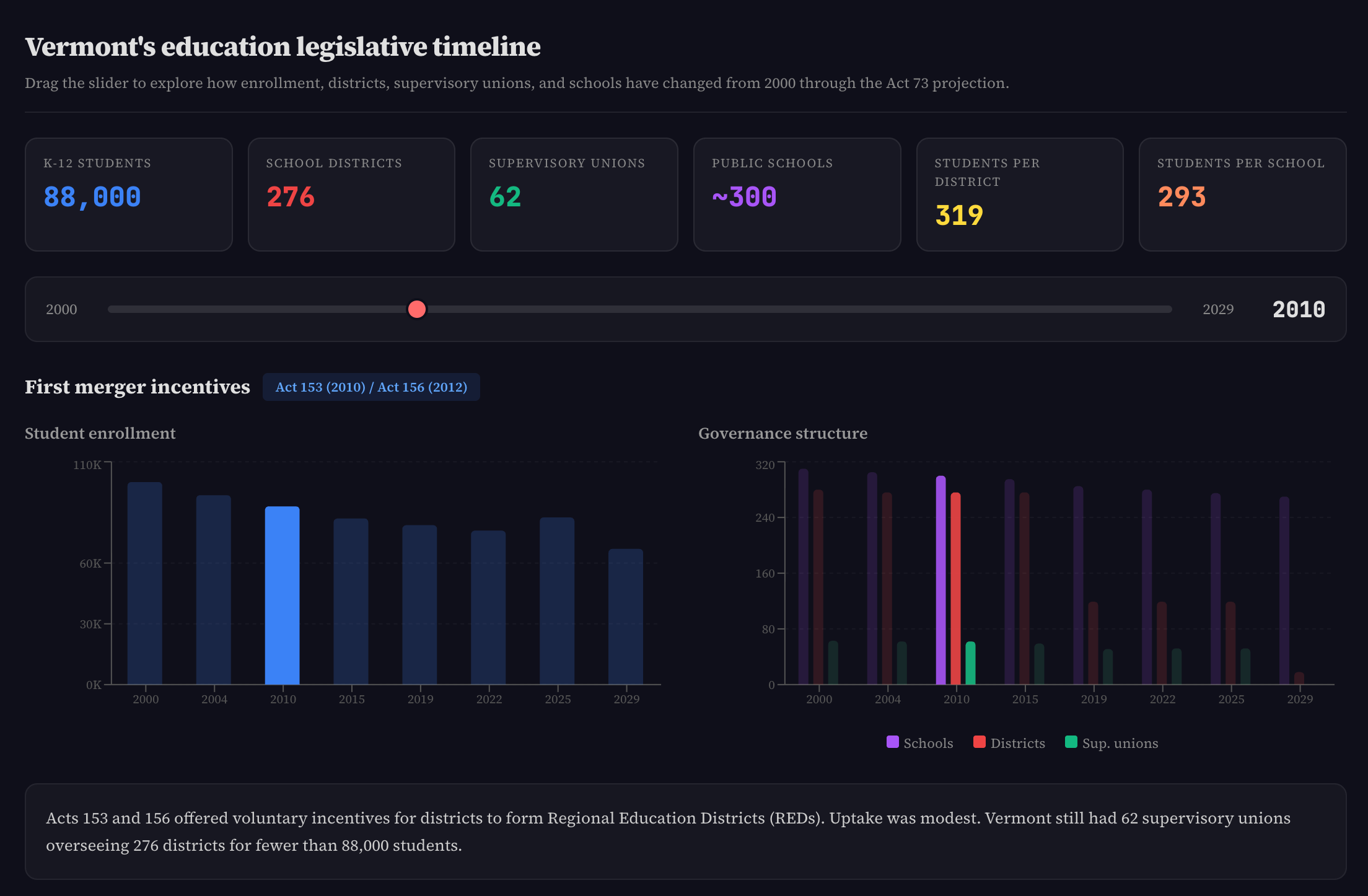
I should be upfront: I am out of my lane and out of by depth on the policy details here. What follows is my best synthesis, and I welcome corrections from people who have lived inside these debates far longer than I have. I’ve also added an interactive “Legislative Timeline” to the dashboard (under the “Act 73 Impact” dropdown) that lets you scrub through the years and watch how enrollment, districts, supervisory unions, and schools have changed since 2000.
Act 60 (1997) and Act 68 (2003) built the modern framework after the Vermont Supreme Court’s Brigham decision ruled that property-wealth-based funding was unconstitutional. The core principle, that education funding should be equitable regardless of where you live, underpins everything since.
Act 46 (2015) was the consolidation push, merging 206 districts into 50 new union school districts (a net reduction of 156). Did it work? A Yale thesis found no significant change in overall spending or tax rates. Vermont Public reported that merged districts saved about 6.5% on administration but spent more on salaries and services, effectively redistributing dollars without reducing the total. The biggest cost drivers (staffing, healthcare, special education) were left untouched.
Act 173 (2018) overhauled special education funding, shifting from reimbursement to census-based block grants. The intent was good (more flexibility, earlier interventions), but roughly three-quarters of districts received less funding, and implementation was delayed multiple times. Act 73 now calls for yet another comprehensive review of the system Act 173 created just a few years ago.
Act 127 (2022) hit closest to home. It updated pupil weights so that higher-need students (poverty, English learners, rural) counted for more funding. Norwich was among the hardest hit, losing 19% of its weighted pupil share. The redistribution was the explicit intent of the law, but it collided with expiring federal COVID aid and rising healthcare costs, producing a roughly 20% average tax increase and a wave of defeated school budgets statewide. Education Secretary Saunders acknowledged that even after reweighting, high-poverty districts were still not seeing “meaningful difference in resources.” That volatility is the immediate catalyst for Act 73.
So where does that leave us?
Act 46 rearranged governance. Acts 173 and 127 tweaked how we count students and reimburse costs. Each tackled a piece of the system within the existing framework. And each, in relative terms, was more modest than what Act 73 is attempting.
Act 73 is trying to replace the framework itself: new governance structure, new funding formula, new tax mechanism, all at once. The pro-73 argument, as I understand it, is that the prior reforms each addressed a slice of the problem in isolation, and that’s why they kept colliding with each other. A foundation formula, the argument goes, creates a unified architecture where governance, funding, and accountability can work together instead of at cross-purposes.
The counter-argument, which I think also deserves honest engagement, is that Vermont has now attempted major structural reform four times in a decade, and each time the promised savings and outcome improvements have not materialized as expected. Skeptics worry that Act 73’s ambition is precisely the risk: it’s a massive, complex change to a system that serves real children in real communities, and the consequences of getting it wrong are not abstract.
I’m certainly not equipped to know if this is the right solution. What I do know is that the status quo, spending the most in the nation for outcomes at or below national averages while the tax burden drives young families away, is not a defensible position either. Arguing in support of doing nothing strikes me as intellectually dishonest, even if arguing about what to do instead is genuinely hard.
What I Take Away
I’ll finish where I started: I love Vermont. I love Norwich. I love Marion Cross Elementary School and the teachers who make it what it is. This isn’t a case for despair. But it is a case for honesty.
Vermont is spending among the very most per student of any state in the country, and getting results that are, at best, average. That gap is not explained by teacher salaries (below average), and it is not explained by some unique Vermont virtue that justifies the premium. It is explained primarily by a structural problem: too many administrative units, a staffing baseline that has been the most intensive in the country for two decades, all serving a population that has been shrinking for twenty years. And it’s compounded by an affordability crisis that makes it harder every year to attract the young families whose children would fill those schools and whose tax dollars would support them.
If our spending produced outcomes that meaningfully exceeded national averages, we could all feel proud of the investment. Spending the most for outcomes at or below national trends (which are themselves moving in the wrong direction) is not sustainable.
I don’t know exactly what the right policy answer is. Act 73 is an ambitious and imperfect attempt. Consolidation will be painful and politically difficult. The formula will create winners and losers, and Norwich is currently positioned as one of the biggest losers. These are conversations worth having, and having well, with good data and open minds.
But if I’m being honest about what I think the most structurally durable solution looks like, it isn’t just about how we divide up a shrinking pie. It’s about growing the pie. Vermont needs to become a place where more young families can afford to live, want to live, and choose to stay. We need more young people. We need more children. We need more economic opportunity. Every demographic trend in this piece points to the same root cause: Vermont is pricing out the very people whose presence would ease the fiscal pressure on our schools, our tax base, and our communities. Lower the cost of living, reduce the tax burden, build more housing, create the conditions for economic growth, and the enrollment numbers start to work in our favor instead of against us.
To be clear, this should happen in parallel with education reform, not instead of it. Act 73’s consolidation effort and formula redesign address real structural problems that would persist even with better demographics. But no formula can substitute for actual students in actual classrooms. The math only works if people want to be here and can afford to stay.
That’s what the dashboard is for. Please explore it. Challenge it. Tell me what I got wrong. I built it for myself, and now I’m sharing it because I think the conversation is too important for any of us to sit out.
Visit the dashboard at vtact73.com. Please read the disclaimer page carefully. If you have questions, corrections, or better data, I genuinely want to hear from you.
Complete Source List
Vermont Joint Fiscal Office (JFO), “Estimated Act 73 Foundation Formula Impacts,” Draft Analysis, February 23, 2026. Authors: Julia Richter, Ezra Holben. vtact73.com/jfo-preliminary-modeling.pdf
National Education Association (NEA), “Rankings of the States 2024 & Estimates of School Statistics 2025,” April 2025. Teacher salary, starting salary, student-teacher ratio, per-pupil expenditure (FY 2023-24). nea.org
U.S. Dept. of Education, NCES, Digest of Education Statistics 2023, Table 236.75. Per-pupil current expenditures by function and state, SY 2020-21. nces.ed.gov
NAEP, “The Nation’s Report Card,” State Profiles, 2003-2024. 4th and 8th grade reading and math. nationsreportcard.gov
NAEP Data Explorer, detailed state-by-state longitudinal scores. nationsreportcard.gov/ndecore/landing
Urban Institute, “States’ Demographically Adjusted Performance on the 2024 National Assessment.” urban.org
U.S. Census Bureau, American Community Survey (ACS) 2024 5-Year Estimates. Population, demographics, median household income, housing values. data.census.gov
Tax Foundation, “2026 State Tax Competitiveness Index” and “State and Local Tax Burdens by State (2022).” taxfoundation.org
WalletHub, “Tax Burden by State,” updated April 2025. wallethub.com
NFIB, “Which Tax Track Will Vermont Take?,” February 2026. nfib.com
Vermont Housing Finance Agency (VHFA), “Vermont Housing Needs Assessment 2025-2029,” Chapter 5: Homeowners. vhfa.org
Hickok & Boardman Realtors, “Vermont Market Report,” Early 2026. Statewide and regional median sale prices. hickokandboardman.com
Public Assets Institute, Charts & Infographics. Housing affordability, income vs. home values, rent trends. publicassets.org
NCES, Common Core of Data (CCD), Public Elementary/Secondary School enrollment by state, 2004-2024. nces.ed.gov
NCES, Digest of Education Statistics, State-level dashboard (enrollment, staffing, expenditure trends). nces.ed.gov/programs/digest-dashboard/state/vermont
USAFacts, “What is the income of a household in Vermont?” Census-sourced data. usafacts.org
Vermont Dept. of Taxes, Property Transfer Tax data via housingdata.org.
CCD/NCES, National Public Education Financial Survey. State fiscal data, revenues and expenditures.
Census Bureau, School Finance Survey (F-33). census.gov/programs-surveys/school-finances.html
Vermont Open Geodata Portal, Supervisory Union boundaries (ArcGIS). geodata.vermont.gov
Green Mountain Care Board / Vermont-NEA, “Healthcare Reform Urged by Educators and State Employees Could Have Saved $400 Million Over Five Years,” December 2024. Reference-based pricing study. vtnea.org
ValuePenguin / LendingTree, “Average Cost of Health Insurance 2025.” Vermont premiums 86% above national average. valuepenguin.com
VTDigger, “Vermont health insurance costs are among the highest in the nation — and rising quickly,” August 2024. vtdigger.org
Vermont Agency of Education, “State Education Profile,” August 2024. Staffing levels, per-100-student ratios. education.vermont.gov